Sunday, April 7, 2013

Why I Torture Myself, a/k/a Why I Run

How it looks is exactly how I felt - finishing a 10k race in March 2013
Yesterday morning, I woke up five minutes before my alarm clock would have sealed the deal - 6:55 am.  I slowly went through the pre-run preparations that allow me to run long distances (or, perhaps more accurately, keep me from feeling the negative after-effects of running long distances).  Fully stretched?  Check.  Guzzle down some water and fill up my nerdy as all hell fuel belt with 10 oz water, 10 oz Gatorade?  Double check.  Space age, fourth generation Gore-Tex long sleeved shirt and running pants?  Status achieved.  Body Glide (don't even ask)?  Absolutely necessary.

As I stumbled down the two flights of stairs in the Cape May bed and breakfast inn where my wife and I decided to get away for a relaxing weekend, I was thinking to myself, this is technically a vacation, my wife's up there sleeping like any sane person would be sleeping at 7 am on a Saturday morning on vacation, and I could be sleeping, too, for at least another hour and a half or so.  What the hell am I doing?

We'd been to Cape May, damn, I'd have to say this was the fifth time we'd spent a weekend in this town.  Because I treat this town as a place to unwind and relax, and because I generally do not associate distance running with unwinding or relaxing, I'd actually never run a single step within Cape May city limits before*.  But this morning, this unseasonably frigid April morning with temperatures barely above freezing and a complimentary 25 mph swirling wind, just to make things extra interesting, I was going to run the streets of Cape May.

(*NOTE: I'm fairly certain this is true, as I have meticulously kept statistics on every run I've taken since January 2008 in an Excel spreadsheet, but it is possible that I did run Cape May on a visit prior to 2008.  I encourage every runner to keep notes about each run - I keep date, distance, time, pace (calculated by Excel), location, and notes.  My "notes" generally include brief details about how I felt, whether I ran alone or with a friend, the weather that day, and any special achievements or items worth jotting down.)

The problem with this particular run was, it was God-awful terrible.  Specifically it was terrible in the worst possible way - I am generally a healthy and strong runner, but my one long-term weakness is cold and windy weather when I don't have my ski gloves.  I have poor circulation in my hands, and I also react awfully to frostbitten hands in a total body, almost autoimmune sense.  Now, every runner has to give up on a run (I call it "bonking", a phrase I learned from my father) once in a while, but 2013 had - to this point - been a banner year so far in the not-bonking category.  I had run dozens of times up to that point, under different conditions and for different distances, without a single bonk.

But 3.3 miles into a scheduled six-miler, I had to pack it in and walk back to the bed and breakfast, muttering curses under my breath, shamed by the road.  When I returned to the relative comfort of our heated room, it still took me another ten minutes for the frostbite to subside enough for me to relax and actually take a shower and get along with my day.

****************************

Today's run was the complete opposite experience, by the way - seven miles at a comfortable 8:34 pace (how many of you knew that was 7.0 miles per hour?) at a local park.  Though it was still breezy outside, the weather had warmed to sixty degrees and as a result I was able to run in a t-shirt and shorts.  The park was buzzing with people, as today was the first truly spring-like weekend day of the year, and this actually inspired me to run faster.  As much as I hated yesterday's attempt at running, today was an example of why I run.

The health benefits of a moderate amount of running (let's call it 15-25 miles per week, though everyone is different) are pretty much indisputable.  A man my age and my size burns 150 calories per mile; running twenty miles in a week burns 3,000 calories, so it's pretty difficult for me to gain weight when I'm able to run twenty miles per week on average.

Mentally, the benefits are just as clear.  Twenty miles is about three hours per week spent running, at my current pace.  Whether it's on a treadmill or outdoors, that is a great deal of time for organizing one's thoughts and working through one's troubles.  Outdoor running is also forced sun exposure, which - in addition to a relatively strong early season farmer's tan - has mental health benefits as well.  People get SAD (Seasonal Affective Disorder) for a reason, and I'm fairly prone to feeling down in the winter time as well.  When winter finally starts transitioning into spring each year, I can't wait to get outside and run.

These are benefits for anyone, and they are relative to each person's previous health condition.  A sedentary person could complete a "Couch to 5k" running program and achieve notable health benefits, just because of where they were before.  I'm a repeat half marathoner (my seventh half marathon will take place later this month) so it's a bit more challenging for me to push the health envelope - I would either have to run longer, which I do not want to do, or run faster, which I am begrudgingly attempting to do.

********************************

I run to escape my problems, and I intend to be completely transparent about that.

I run because if I didn't run, I would eat the same way I currently eat, and consume the occasional few beers the same way I currently drink the occasional few beers - but I would not feel, act, or look the same way I do right now, because I run.

I run to compete against myself, because I'm years out of school now and I'm still addicted to competition.  Until you graduate college (or, I suppose, law school if you're a lawyer or med school if you're a physician), you're constantly competing intellectually against your peers.  If you're a talented student, you learn to love the competition (because you're used to winning, for the most part).  But in corporate America, I have found that score keeping is vague, competitions are few and far between, and you don't know who wins and who loses until everyone retires.  So I run to keep that spirit of healthy competition alive.

I run to be social, which is weird because for many people running is a solitary endeavor, and it is weird because I'm not a very small-talky, chatty person in my everyday life.  Put me in a race environment, though, and I become best friends with people I've never met before (I am also like this at bars and at playoff baseball games; random strangers bear hugged me after Mark Teixiera hit a walk-off home run in a 2009 playoff game against the Twins - I guess I am just very huggable). 

I run to live longer, because I'm convinced that the human heart wants to be pushed (within boundaries, as ultra marathoners are hurting themselves without a doubt) and the human heart does not want to beat a hundred times per minute at rest.  People disagree with me on this, and that's fine - I concede that runners have been known to drop dead from time to time - but in a very macro sense, an average, moderate runner should see more years on this planet (and more of those years should be healthy years) than someone who does not run at all.

Finally, I run to experience running.  Running hurts, and frankly running sucks sometimes.  But you learn a great deal about yourself through running distances, breaking down your own mental barriers, running with people, and becoming enraptured in the process of simply putting one foot in front of the other, quickly, for an extended period of time.

********************************

I do not, on the other hand, run for the following reasons:
  1. To compete against others;
  2. To be "good" at running;
  3. To push myself further and further every single time;
  4. To crawl through mud, climb fences, be cut by razor wire, etc.
The above are perfectly reasonable reasons for a person to run (hey, whatever toots someone's noodle is none of my business, as far as I am concerned), but I simply cannot run for these reasons. I am not certain why I am not a very fast runner - I assume it's a combination of my genetics and my just not wanting to work that hard at anything - but I know that I lack the mental and physical fortitude to become a very fast runner.  Plus, as a recovering fatty, there's no way I would ever combine dieting with a distance running plan.  I run to compensate for my unhealthy nutritional choices and nonetheless remain relatively skinny; if I were to eat too healthy while running so much, I would lose too much weight.  Nobody likes a stick figure Fred.

I can't push myself further and further every time because then I'd burn out and stop running altogether.  For someone who races fairly regularly, I am exceedingly prone to running burnout.  I have my share of problems with running journalism (e.g., Runner's World), one of which is the assumption that the readership runs because they love and/or are addicted to running.  I face palm every time I read these articles about post-race recovery plans that include things like "We know the first thing you want to do the next day after a half marathon or marathon is get back on the pavement.  Fight that urge."  Um, I'm sorry, what?  Please tell me this is sarcasm and I am just not getting the joke.  After racing 13.1 miles and leaving every ounce of energy I had on those 13.1 miles of pavement, I barely want to drive down a road for the next week or two after the race, let alone run on pavement.  I get pavement PTSD.  I can't even listen to shitty 90's grunge rock, that's how scared I get of Pavement.

And finally, there is this totally okay for other people, but not for me, running subculture of these "tough guy" runs.  I was reading an article about how these "tough guy" Spartan runs attract type-A, masochistic macho stock trader types - the kind who pump iron because they just want to be awesome, brah.  Apparently these guys crawl through sewer pipes and have their nipples plugged into electrodes just to finish these "races", which are loosely inspired by Marine Corps boot camp hell weeks.  So to each their own, I suppose.  You guys should have fun at your Goldman Sachs sausage festivals, and I'll just stay the course and enjoy running regular races, which I guess will now consist of only regular guys and all of the women.  Sucks to be a regular guy, I guess.

********************************

I will know that I love running when I am able to run consistently for a year without any sort of break.  As of the present time, I have never been able to pull this off.  I typically train hard through the winter and early spring for a half marathon; then break for a while and hardly run at all for most of the summer (just three miles here or there).  Then I pick it up again in the late summer and through the fall for a second half marathon; then I break for the holidays.  For all I know, this strategy (if you can call it that) has kept me from becoming seriously injured while running.  But still, I would appreciate a year's worth of consistency for consistency's sake - just so I know I could do it.


Monday, April 1, 2013

Luck be a Lady: Preparing for the 2013 World Series of Poker


After about a decade of playing the game seriously, and after years of vacillating back and forth on whether or not to do it, this year I am finally crossing an item off of my bucket list by playing in the World Series of Poker.  The real thing, a major poker tournament with a $1,000 buy-in, and the chance - if everything goes right and the cards fall my way for three days straight - to bring home a real champions' bracelet from Las Vegas.

This is a story you may have heard before, at least partially, if you've ever played the game of poker seriously enough to wonder how - maybe if you went out to Vegas just once, and somehow got incredibly lucky while you were out there - you might actually compete among some of the strongest players in the world.  It's what happens just before the closing credits of "Rounders", after Mike McD breaks Teddy KGB's spirit and crushes his pride.  It is the kind of pipe dream spoken across many a low-stakes home game, and it's the reason why lots of true amateurs play satellite tournaments (even now, in the post-poker boom years) just for the chance to buy into a real Las Vegas World Series of Poker tournament.

**************************

So here's how I fell in love with the game of poker: it started, I suppose, with card games for nickels and dimes against a few family members when I was about eight years old.  I was then greatly assisted by Hoyle Casino, a PC game released by Sierra Entertainment about twenty years ago.  This game taught me how to gamble digitally for play money, and it also taught me aggression - it's very easy to gamble all of your chips on one hand when they don't count for anything.

And you can't forget the incredible influence of the Jersey Shore arcade culture.  I don't know if it's like this anyplace else in the United States, but if you grew up anywhere near a beach in New Jersey, you were almost perpetually exposed to arcade environments that were everything but an actual brick and mortar casino, except the cigarettes were made of candy and the video poker games gave you tickets, instead of money, for a made hand.

While other six-year-olds played Skeeball or Pole Position at the Bev and Wally's arcade at Keansburg Boardwalk, I was playing some medieval predecessor to Triple Double Bonus Video Poker.  Gambling (like other vices, I suppose) is a culture, and if you grow up in New Jersey and don't gamble, it's something like growing up in New Orleans and not eating gumbo (or drinking hurricanes).  Your parents must have been really lame, or evangelically opposed to the act, or some combination of the two.

Then, finally, for my 21st birthday, I received Doyle Brunson's "Super System" - which was, by then, already established as a book of gospel in the canon of poker literature and strategy - as a gift.  I couldn't get through more than half of the book because it focused on Texas Hold 'Em, a game I barely understood, even though I'd recently started watching ESPN's nearly non-stop coverage of the World Series of Poker.  With time, though, I started to understand the game enough to compete for real money.

***************************

Lost, now barely a footnote among the various hyper-televised sports fads of the very early 21st century, is the fact that for several years in the early- and mid-2000's, playing poker and being a poker fan was an incredibly, openly cool thing to be.  ESPN's television coverage of the game (which recently debuted hole card technology allowing casual viewers to view the exact card holdings and strategies of the players) was a major factor in this.

So was the considerably culturally subversive nature of the game; the fundamental idea that the assortment of sociopaths, social misfits, math geniuses, criminals, cokeheads, and general unwashed that we all collectively called "poker pros" could somehow consistently win money through bravado, deductive reasoning, and luck.  There was an inherent logic to the game, that the odds favored the strongest players over time, and that with patience, prudence, and better than average luck, a regular guy or lady off the street could even make it big themselves as a poker player in Las Vegas.

To me (and maybe only to me, given how poker participation has been declining over the years), there's something that remains fundamentally attractive (in the general, non-sexual sense) about all of this.  Even if the poker boom has already faded, with the easy money provided by regular guys and ladies drying up, and the Department of Justice's 2011 crackdown on major online poker sites uncovering the thin truth that the most popular online gambling site used by American casual gamblers was actually a massive Ponzi scheme orchestrated not by Bernie Madoff but instead by some of the most famous "poker pro" faces you or I had seen on the television screen.  Poker still remains a beautiful game, at least to me.

Perhaps it's my countercultural streak (which, admittedly, runs too deep), but even now, years after interest in poker passed most casual fans of the game by, I still have the itch to find out how I'd do in Las Vegas.  And in just a couple of months, I'll be able to scratch that itch.

*****************************

My career as an amateur poker player is, objectively, slightly above average, and that's it.  On a good day, I can walk into a poker room rusty as all hell and take money off of experienced and practiced player; on a good day, I really can read the entire poker table, the game moves in slow motion, and I can sometimes legitimately feel as if I am printing money (in a cash game) or tournament chips (in a tournament).

The massive problem with my game is that, most of the time, it's difficult for me to know whether I am having a great day or a terrible day until it's too late.  By "too late", I mean that on my terrible days, I can't stay at the poker table long enough to figure out which side is up.  After years of deluding myself about this weakness, I now understand it better, and imperative among my goals for the World Series of Poker is to play with enough patience, particularly in the early going, to understand (a) what kind of day I am having, (b) how I am feeling, and (c) how I should handle the game in response to (a) and (b).

Over the years, I've had some large cashes, most notably a cash for $3,000 in the summer of 2009 and a separate cash for $2,100 in the summer of 2012.  I also made a final table at a poker table on a previous trip to Las Vegas (though for very little profit). I am reasonably certain I am "up" (i.e., profitable) over the very long haul, though this assumes that I invest 100% of my winnings in my poker bankroll - more often than not, they are reinvested into rounds of drinks for my friends at the casino bar.  I am just as certain, though, that my game is flawed and I will need to get fairly lucky in order to play deep and be successful in a $1,000 buy in event in Las Vegas.

*****************************

Here are some things I know to be true:
  1. The caliber of poker player is stronger in Las Vegas than anywhere in the Northeast.  Simply put, many players travel to Las Vegas in an attempt to make it big playing poker.  Vegas then chews up and spits out at least 80-90% of these folks, and sends them back home (to wherever home is for them), flat broke.  That's pretty much a Q.E.D. right there.
  2. I'm best served treating this event as a gamble than as a truly serious venture.  This way, even if I push all-in with kings in the second round and come up short against an unfortunate pair of aces, I can at least dust myself off, say "Oh well", take a walk around the casino, and enjoy the rest of my trip.
  3. I should still study and practice my game, a ton.  Fundamentally, if I start playing this tournament and do find myself getting broadly lucky, I need to be certain my game is optimized, fine-tuned, and spit-shined.  I need to be sure that when I bust out of the tournament, it is on a decision I don't hate myself over in the coming weeks or months.  More than winning or losing money, I want to play a solid game of poker throughout the tournament.
  4. I should also practice the physical aspect of the game.  I've played enough poker over the years to know that stamina is not my strong suit.  Some poker players delight in playing one, two, sometimes even three days straight, barely breaking for a cigarette or some nutrition.  I tend to crap out and get tired or bored after six or seven hours, tops, which pales in comparison to the 30 hours of poker I'll (hopefully) be playing over two straight days in order to make it to the final two tables of this particular tournament.  So in addition to the endurance training I am currently doing for my half-marathon, I am also endurance training through extended sessions at local casinos and poker games.
  5. I should have fun.  Because after all, it's Vegas, a place were dreams come true, and I'm fortunate enough to be able to play in the grandest poker tournament in history.  As a fan of the game, it's incredible that I can do this, and I intend to have fun in the process.
  6. I should try to relax.  Easier said than done - I can be anal retentive and a bit high strung - but hopefully the $47 first class ticket to Vegas (thanks, US Airways award travel!) will help.  A complimentary, pre-flight Jack and Coke should help, no?
 ****************************

My first training session was last Thursday at Sands.  I played $1/$2 no-limit because I felt, in terms of absolute level of talent, the caliber of player I'd be seeing in Las Vegas would be about the same as that of a daily grinder at a $1/$2 table at an above-average casino.  Truth be told, most of the table did know each other already from daily competition, which is never a good sign when you're an outsider who doesn't have much confidence in his game.  Regardless of my jitters and some early sub-standard play, I did take $200 in profits off the table. I will have to play again soon.

As the tournament approaches, my plan is post again with a training update and some more random thoughts.  I'll also post Facebook updates on my tournament play in more or less real time, as the competition ensues.

Monday, March 18, 2013

Fun With Basement Remodeling: Part One

Over the past few weeks, the household (me, the wife, and the Suze) has been enduring a fairly major renovation project; the demolition and remodeling of our basement.  We're about halfway done with the project, and we anticipate it will be finished in a few weeks (hopefully with some help from people that have more experience painting stuff than we do, and who can explain terminology such as "cutting in" - which I know has something to do with either painting corners or being an overly emotional teenager).

It's been a fairly annoying process, owing mainly to the lack of control we have over our house during the work week.  There are various people coming in and out of the house on different days (carpenters, plumbers, electricians, hobos, etc.) and they operate on a fairly early schedule.  We are late risers, and thanks to fairly flexible work schedules, we haven't felt truly rushed to start our days in a long time.  Keeping in mind we know we are spoiled, and also fortunate to have such an improvement take place at our house, it still kind of sucks - even if it's just for the short term (about six or seven weeks).

*******************

Some backstory and some "before" pictures: the basement of our house has always been an eyesore.  One of the primary reasons we purchased this home two years ago was that we really liked the design styles of the previous owners.  They opened up the floor plan considerably, and had very good taste/style - which was good because, while we knew what we wanted, we also knew we weren't very good at making it happen ourselves.  So the house was fairly move-in ready, as a whole.

The basement, however, was not a focal point for the previous owners.  They slapped some beadboard over a few walls, threw a bit of industrial carpet down, and the MLS for the house listed the basement as "semi-finished".  (Thankfully the house was otherwise fine and below our price range in our house search, otherwise we would have complained about that aspect of the listing.) 

On a good day, the basement looked semi-inhabitable.  We used it for beer pong when we have house parties, because it didn't matter to us if crappy beer was spilled on the crappy carpet.  On a bad day, like when the pictures below were taken - after we moved everything out of the basement, prior to demolition - it looked like the kind of place where people go when they are abducted in horror movies.


Here's the aforementioned "semi-finished" section of the basement, before demo.  The room was lit by one naked light bulb in a $3 fixture, and the wall to the left of the screen would crumble if you punched it - it was just beadboard.  Same, really, with the closet wall to the right.  The window in the rear came with the house, in 1955 (they were thankfully replaced with new, insulated windows in the demolition).


And here's the unfinished section.  The utility sink - made of plastic, and with only three functioning legs - was fed by pipes that were originally covered with asbestos.  Yeah, asbestos.  Thankfully that is gone now.  The washer and dryer are currently in our garage, and April and I have been driving to her parents' house across town to wash clothes the last few weeks.  This is only slightly better than the college dorm lifestyle, since her parents don't charge us anything.


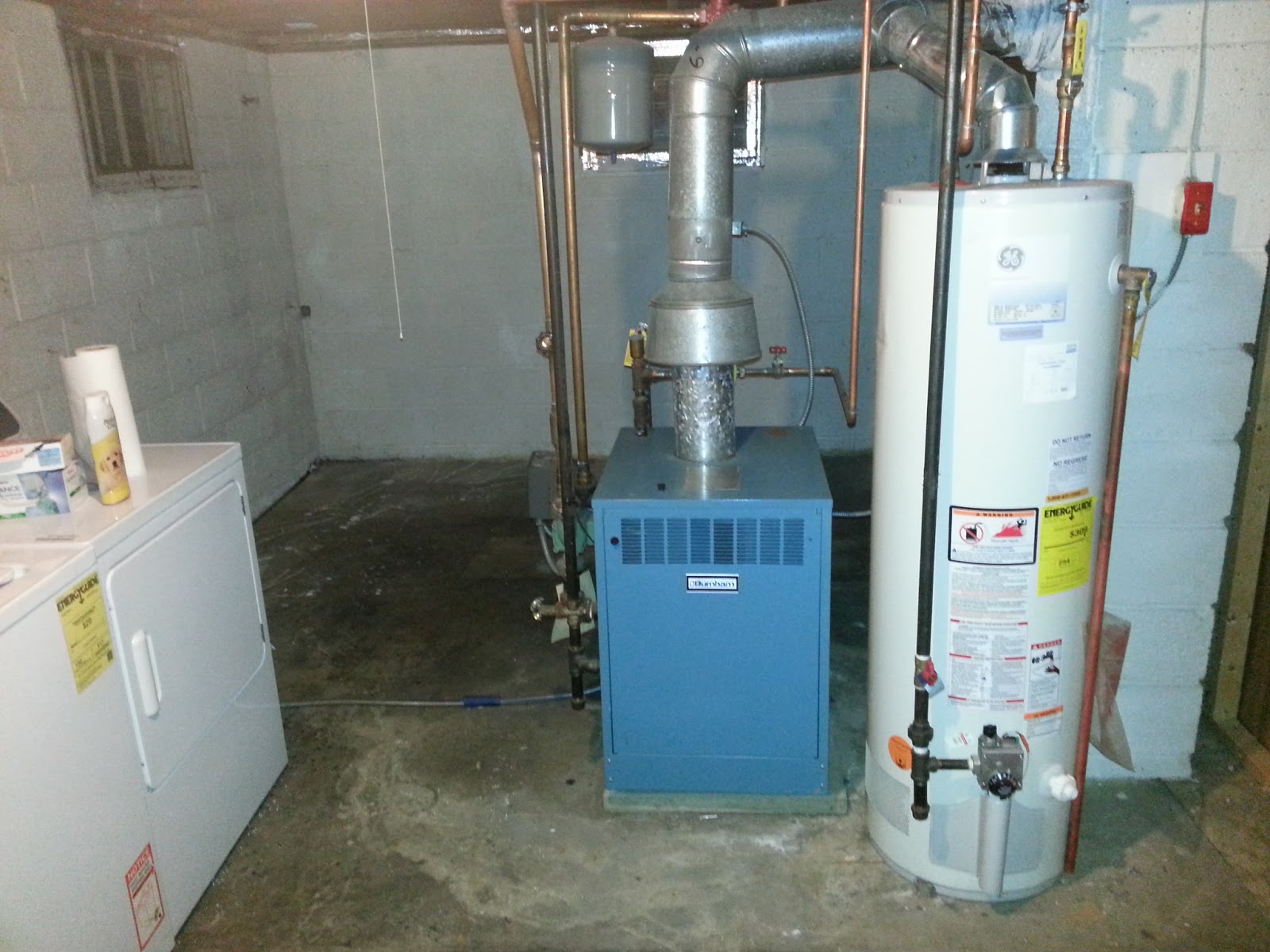
This is clearly the most rape-y part of the basement.  Our house is heated by a gas-to-hot water boiler (the blue box on the left).  Boilers are a wonderful way to heat your house; baseboard radiators keep the relative humidity of your house relatively high in the winter, compared to furnace hot air heat.  Additionally, they require less maintenance and are generally more reliable - the boiler in the picture above was assembled in 1983.  Like the author of this post (also assembled in 1983), it occasionally requires some routine maintenance. 

Notice that hose on the floor, behind the dryer?  That was the previous owners' cheap fix - the hose was attached to a leaky pressure relief pipe.  Turned out the expansion tank (that grey cylinder hanging from the pipe) had blown years ago and every time the heat kicked on, the pressure inside the boiler increased to 60 psi (it should be less than 20 for safe operation).  When the demo guys removed the hose, the pipe started leaking dirty water all over the concrete floor.  Replacing the expansion tank was an additional, unexpected cost about $200 - one of those extra monetary hits you should always plan on when budgeting a home improvement project, because they always happen.  Bottom line, replacing the tank was cheaper than replacing the boiler (though that will eventually have to happen, too).

******************************

Below are the more recent pictures, after three weeks of work in the basement:
  • Week 1: Demolition/boiler fixing
  • Week 2: Framing
  • Week 3: Rough plumbing/electric
At the time the pictures were taken, the project had just finished the preliminary inspections for electric, plumbing, and building/fire.  (In case you were curious, insulation - the fourth inspection - happened today, and now the carpenters can start sheetrocking, spackling, and doing "trim".  After that's done, and after we are satisfied with the work completed as the homeowners, there are final inspections for electric, plumbing, and building/fire.)

You can see that though the basement remains very much a work in progress, it also looks much different than before.  Here's the first picture:


The crappy window has been replaced, and wood studs jut out from the walls.  There's also a grid dropping down from the ceiling (after sheetrock, the ceiling is approximately 6'9", just high enough to not give me claustrophobia), and the lights will be recessed in those metal jackets you see above.  To the right is a closet, which will remain unfinished (but hidden from view using doors).  Our plan for this room is a media room; there will be a couch and possibly a recliner on the back wall that you see here, with a wall-mounted TV on the opposite wall.


Above is the space behind the boiler and hot water tank; this will eventually become the second full bathroom in the house.  You can see the hot (red) and cold (blue) water distribution lines, as well as the drain pipe (that's the larger, PVC pipe).  To the right is our new, space-age ejector system.  It turns out you have two choices when it comes to the removal of water/waste from a basement; you can either use gravity (which in this case would require drilling into the concrete foundation, a logistical nightmare that would also be extremely expensive) or you can use an above-ground ejector.  That white box (known, in technical parlance, as a macerating, upflushing sewage system) does all of the literally dirty work involved in pushing refuse from a toilet, sink, and shower to the house's standard sewage pipe.


And finally, this is the new laundry room - the white box is where hot/cold water will enter the washing machine.  There's a horizontal pipe below, which will lead from the utility sink (not pictured, to the left) to the washing machine and to the house's main sewer pipe (that big pipe to the right).

*************************

It surprises me that, with all of the extra stuff in our basement in terms of framing, plumbing, electrical, and (now) insulation and sheetrock, the room looks bigger now than it did before.  Our basement is not a huge space; it's maybe 450-500 square feet of livable space, once the project is finished.  But when you're downstairs, it looks much bigger than it is.  I cannot wait to sit down in a finished basement, prop my legs up in a reclining chair, and watch a baseball game this spring.

What's next?
  • Week 4 (this week): Sheetrocking
  • Week 5: Sheetrock (finish)/Trim (start)
  • Week 6: Trim (finish)
So, fingers crossed, the project will be finished around the first week of April.  If people are interested I will post pictures of the finished product in a later blog post.

Saturday, February 16, 2013

A Cost/Benefit Analysis of Driving Like a Douche

If you're like me and have a long commute, you've probably had plenty of opportunities to observe another driver do something so spectacularly rude, dangerous, or illegal that you may wonder to yourself: how can anyone possibly do that?  Looking at it rationally, there are tons of legitimate reasons why absurdly "outside the rules" driving can happen - for instance, the driver in question could be driving to the hospital because their wife is about to give birth, or their child or parent could be critically ill.  At least, this is what I tell myself while barely holding back my fuming rage that people are able to break the rules so egregiously, always without a police officer nearby.

But, let's face it: sometimes when you see this happen, it's just some rich asshole who is in a rush to get somewhere, and doesn't feel like playing by the same rules the rest of us face.  Upon realizing this, it made me wonder: how much value would a person have to place on their time in order to willingly take the approach of damn the torpedoes, my 150' yacht ain't sailin' itself and I need to get to the marina, I'm riding this goddamned curb all the way to Rumson?

Well, not really.  Since I'm a selfish asshole, I was really first curious about myself: given the realities of getting pulled over, the length of my commute to work, and the value I place on my time, would it make sense - from an economic cost/benefit perspective - to drive like more of an asshole than I currently drive?


*********************************

Now "driving like an asshole" is a fairly abstract concept, so to keep things as simple as possible, I wanted to focus on one fairly common traffic law - a rule which most of us break from time to time: running red lights.  Specifically I wanted to know: what is the theoretical "break-even" point in which a person's time is so valuable such that they "shouldn't really care" about running a red light on occasion?

(NOTE: What follows is a completely amoral analysis, and leaves aside for the moment the very real truth that traffic laws exist for a reason, which is to save lives.  So please keep in mind this an intellectual exercise, and even if the results suggest that I "should" run more red lights from a purely economic perspective, I'm not really about to start driving like more of an asshole than before, because I really do care about laws and rules and such.)

I have a long (thirty mile) commute to my work place, and in each drive to or from work, I hit approximately thirty traffic lights.  And I'll admit that sometimes, in my impatience, I run yellow lights just after they turn red.  I do so because, in my gut, I felt like the risks of occasionally getting pulled over are outweighed by the likelihood that I do get pulled over AND get a ticket.  But I didn't really know this for sure, so I decided to crunch a few numbers in Excel and find out, roughly, how valuable an hour of someone's time would need to be in order to "come out ahead" money-wise while always speeding through yellow-to-red lights.

To be honest: I had to make a ton of assumptions in order to come to a conclusion, some of which are fairly abstract and open to interpretation to someone who disagrees.  In my analysis, I've tried to be completely forthcoming about where I've made these assumptions.  I did this because if you're one of those readers who loves crunching the numbers on their own, and if you find places where we disagree, let me know (especially if it fundamentally alters the result). 

But, if you think I'm awesome and quantitatively infallible and just want to know the answer, here it is:
  • With my New Jersey commute, I would need to earn only $43,326 per year in order to offset the cost of obtaining a violation for running the occasional "late yellow" or red light.
  • Because people with shorter commutes have fewer opportunities to fail and therefore would go longer between obtaining violations, commute time largely doesn't affect the result of the calculation.  A New Jersey driver with a 15 light/day commute would need to earn only $41,828 to offset this cost.
  • Drivers outside New Jersey, being kinder, more moral, and better drivers in general than those inside New Jersey, would never consider such an evil possibility, and therefore are excluded from this analysis.
If you don't want to get into the nuts and bolts of the analysis, you can skip the entire next section entirely.

******************************
 
As I mentioned earlier, this analysis primarily stems from a personal curiosity about my commute.  So I'll start with that example and then address how this applies more generally to other people's commutes.

First, how frequently would I get pulled over if I always sped up at yellow lights?

Here are the facts:
  • I hit 30 lights on each drive to AND from work (60/day)
  • I drive to work 4 days/week
  • So each week, I hit 240 lights
  • The average "cycle time" for any given light is 60 seconds, and in those 60 seconds, a light is yellow for 4 seconds (about 7 percent of the time)
  • So, each week, I should hit about 16 yellow lights out of the 240 total lights I encounter.  That's 832 yellow lights per year.
  • I have zero points, presently, on my driver's license.
Here are my assumptions:
  • Yellow light situations turn into "running through red light" situations fairly infrequently, let's say ten percent of the time.
  • Cops are rarely around - in fact, I would guess that cops are only around one out of every hundred times a person makes a poor decision and runs through a red light.
  • I am polite with police officers when pulled over and therefore I am somewhat less likely than the average driver to get a ticket when I am pulled over - let's say one time out of every three that I'm pulled over (for something nominally "minor", such as running a red light), I get a traffic ticket.
 Given this,
  •  I encounter 832 yellow lights per year while driving to/from work (I assume that in my spare time driving, I'm more laid back and will always defer toward not running red lights), and I make 83.2 poor decisions on a yellow light per year.
  • I would get pulled over by a police officer one time out of each hundred poor decisions that I make, so I would get pulled over once every 439 days (about every 14 months).
  • But because I only get a ticket one time for every three that I'm pulled over, I only get a ticket every 28 months.
Second, what are the costs (time + money) for getting pulled over?

It makes sense here to explain the assumptions first, since the facts are pretty straightforward:
  • Assume, if given a ticket, I come across the most hard-ass judge in New Jersey, and I'm forced to pay the maximum fine for the violation AND I also get two points on my driver's license.  Realistically, the penalty for this violation would be far more lenient, but remember the exercise assumes that I turn into a radical douchebag driver.  So we should assume, being a douchebag, I'm going to insult the judge's mother's sexual proclivities while in court, and as a consequence they'll come down hard on me.
  • Assume also that after the judge throws the book at me, I decide to offset the points on my driver's license by taking a defensive driving class (you can do these every two years, which is good news for me because I'm now acquiring tickets every 28 months).
Here are the facts:
  • I'd be getting the maximum fine of $200 for the violation, which plus maximum court costs of $39 is $239.
  • The defensive driving course would be $35 (let's say I take the one offered by Rutgers, since it's close).
  • It would take up a full weekend day, and I love my weekends because I get to write obscenely complicated blog posts, so let's say the opportunity cost would be $400 (this is the cost I'd put on eight hours of my freedom on a weekend day).
 Given this,
  • The total cost of getting a ticket would be $239 + $35 + $400 = $674, every 28 months.
Finally, how much would a theoretical driver have to earn at their job in order to make it "economically okay" to withstand this cost; that is, how much value would a person have to place on the time saved by running the red light in order to offset the cost of getting the occasional ticket for running red lights?

Here are the facts:
  • In my specific commuting situation, I would save 13.86 hours per year (just trust me on this) by running through each yellow light I encounter (compared to always stopping).
  • Over a period of 28 months, the theoretical time between receiving tickets, I would save 32.35 hours by being an asshole and running through every yellow light.
Now we can coast in to the final number: just by dividing the cost of each ticket ($674) by the number of hours saved by altering my behavior in a way that makes it way more likely for me to get a ticket, I get $20.83 per hour.  That number (which is $43,326 for a full-time, 40 hour a week, salaried employee) is the break-even point.  A person who values their time at higher than $20.83 per hour, in New Jersey, would end up "making more money" in the theoretical long run by gunning it through every red light and risking the occasional ticket.

But what about a driver with a more "typical" commute, let's say fifteen traffic lights a day (seven or eight in each direction)?  This driver would save less time than I would, of course, by running through red lights (they would only save 8.07 hours every 28 months), but they would also get tickets less frequently than I would as a function of having fewer opportunities to get pulled over (every 116 months, on average).

Plugging these numbers into my formula suggests that these differences essentially cancel each other out; a driver with a shorter commute would only have to value their time at higher than $20.11 per hour (or $41,828 per year) in order to economically justify this approach.

*****************************

I'm sorry that I'm not very confident about the above data, but I'm really not very confident about it.  Even in a best case scenario, where all of the (very smart) people who take the time to read my detailed analysis agree with each of my assumptions, I think the precise figures I stated ($43,326 per year for me, $41,828 for a driver with a shorter commute) should be considered as "shotgun blasts" with a huge margin of error.  In the real world, if I did this, I wouldn't be pulled over - like clockwork - every 14 months; instead, I might get pulled over twice in a month, with a two- or three-year break in between traffic stops.  And of course, over time, the police would start to realize that they are pulling over the same silver Acura TSX for running red lights all the time.  They might start to understand my M.O., destroying my "oh I'm so nice and the police will love me LoLz" assumption entirely.

At the beginning of this post, I suggested that the point of the exercise was to understand the "break-even" point where it makes sense for a hypothetical driver to start running through yellow lights each time they are given the opportunity, considering that in the long run it would make sense financially for them to do so.  Now that I think about it, though, there are other issues at play here as well.

The first is that, even if you disagree with the $43,326 number and think it should be something like $70-$80k/year, either because my assumptions are way off or because you think the "moral cost" of behaving in such a manner would be quite large, it should be fairly obvious that rich people are more likely to drive like douchebags in part because they can afford to drive like douchebags.  Traffic violations are a regressive tax in that (even if you assume that they occur with equal frequency across the income spectrum, which they don't) they hit the pocketbooks of low-income individuals disproportionally harder.  In an ideal world, and forgive me for being a bit of a bleeding-heart liberal in saying this, traffic fines would be a specific amount of a person's income.  $43,326 is a decent individual living wage in the United States in 2013, but if I'm correct about this figure (or even if I am in the general ballpark), it implies that for a sizable minority of people, the "correct" econometric decision would be to run through red lights.  This actually has fairly significant consequences toward public safety.  Turning traffic fines into a progressive tax would render my Incredibly Evil and Morally Reprensible Analysis completely moot.

The second (less academically rigorous) point I'd like to make is that productivity analyses are in the domain of economists and are therefore completely invalid in the real world, because psychology trumps economics in every way possible.  I mean, c'mon, "value placed on my time"?  Realistically, with all that time I'd be saving by running through each yellow light, what would I be doing besides fucking around on Facebook?  I really did take time and care to put together the analysis that precedes this statement, but I think this is just a quirky, intellectual exercise that exists in a vacuum. 

To that end, I'm curious about the extent to which people agree or disagree with what I've done.  (Please don't take this as an excuse to say, "well shit, I'm gonna run red lights now, git 'ir done!", because that would make me sad.)

Wednesday, January 16, 2013

Just Stop Believin': Journey and when your Lead Singer "Dies"

Our cable provider, Verizon FiOS, is pretty terrible.  You know those car commercials where the volume is turned up to eleven so that some screaming salesman hack can tell you about great deals, so you can COME ON DOWN to their dealership and buy yourself a brand new, $8,000 Kia?  Yeah, that's Verizon FiOS' specialty.  It makes me miss Cablevision, the management strategies of the Dolan family, and their in-house propaganda, that's how bad it is.

But one thing FiOS does have is Palladia HD, the all-concert channel that I end up enraptured with, every time I change the channel.  Sometimes, as you may know, I am an insomniac, and falling asleep to a nice live concert is quite relaxing and enjoyable on those nights when I can't just get to sleep.  On Monday night, I found a recent Journey concert from Manila on Palladia and couldn't help but watch for a while.  And then I got angry.

************************

You see, I have a very warm place in my heart for Journey.  It's not that Journey is fantastic (they're not even close to the best band I've ever listened to), but they were in the right place at the right time.  When I was a teenager, I had a penchant for knowing how to use computers (wink wink), and I have a cousin (cousin Nick, who was a groomsman at my wedding, many of you know him) who was very much interested in the underground downloading of music.  I also had a CD burner (which was rare in the late 1990's), and was able to burn a few CDs of 70's and 80's music for him from Napster.  Or maybe it was Kazaa.  But anyway, the point of this exercise was PROBABLY to get me exposed to music from Winger, Skid Row, Van Halen, Def Leppard, and Journey - my cousin also knew how to use a computer - but if that was the case, it worked doubly.  He got his mix CD, and I started listening to the music that he appreciated the most.

And holy crap, was Journey amazing.  I listened to it nonstop.  Some teenagers have moments of understanding what music and life are all about when listening to Guns n' Roses (which I enjoyed) or nu-metal like Rammstein (I enjoyed this, too) - but my heart was with Journey.  It was the perfect musical complement to my emotional state (vulnerable) combined with my levels of self-confidence (notably lacking) and quirkiness (exceedingly high).  Later in high school, after I shed 40 pounds, I found a Journey's Greatest Hits CD in my AP computer science teacher's CD stack (because I was awesome in that way).  I forced the class to listen to the CD each day while we failed at coding in C++ and still have this CD in my iTunes playlist, twelve years later.  I still listen to Journey frequently, as it's followed me through college, work, grad school, and work again.  "Be Good to Yourself," which is admittedly the twenty-seventh-best Journey song, made it onto my first "Running" iPod playlist when I was first getting into running half marathons.  I have serious attachment problems when it comes to Journey.

***************************

Some backstory about the band Journey may be appropriate here.  The major thing that everyone knows about the band, besides "Don't Stop Believin'" (the twenty-eighth-best Journey song) is its lead singer, Steve Perry.  He seems like a strange guy, amazing voice notwithstanding.  After leaving Journey in the 1980s, he disappeared for almost a decade.  Apparently he needed hip replacement surgery (why that requires a seven-year sabbatical from public life is beyond my level of understanding).  He had some sort of solo career, which you'd know about if you liked terrible 80's music instead of awesome 80's music, like Journey.  Now he shows up at San Francisco Giants baseball games and leads the singing of "Lights" during the seventh-inning stretch.

Anyway, for reasons I do not fully understand, he left the band around 1987 and they've rarely/never recorded together since.  But, as my Monday night experience would attest, Journey is still actively touring and still playing their greatest hits from the 70s and 80s.  Their newest lead singer is Arnel Pineda, who essentially performs an extended Steve Perry impression when the band performs live.

Listening to Journey perform live in the twenty-teens, I suppose it sounds "good" in the sense that the remaining four (original as far as we are concerned) members of the band are still fully capable of playing their respective instruments and putting on a good show.  They seem genuinely invested in the propagation of late 1970's arena rock to the newest generation of Filipino audiences.  It sounded like the fans really enjoyed themselves and to be perfectly honest, if someone gave me a ticket to see Journey play at the PNC Bank Arts Center this summer, I'd go in about 1.5 heartbeats.

My issue - what made me angry - was the lead singer.  I get that lots of bands do this, and I think that Arnel Pineda did an excellent job of making Journey sound as much like Journey as possible without Steve Perry.  He hopped around on stage like a man nearly twenty years younger than the rest of the band (which is accurate) and provided what the rest of the band probably thinks is a well-needed burst of energy.

I just don't get the replacement of a lead singer as seminal as Steve Perry.  You don't replace Steve Perry (you can only hope to contain his spirit and singing voice long enough to do a decent job imitating him).  What ended up happening at times during this concert was that Pineda (who was born in 1967 and was about twenty years old when the original incantation of Journey split), in those moments when he was supposed to maximally get into the music, sounded to me like what someone born in 1967 should do when singing a cover song from a legendary band from the 1980's while around his buddies at the neighborhood bar.  By which I mean, karaoke it up and end up sounding just like Meat Loaf (in the worst way possible).

Which is fine at your neighborhood bar, and would impress me there, but here it made me angry.

****************************

I do a terrible job of being a white kid born in 1983 raised in decidedly middle-class surroundings in New Jersey.  I should love the band Sublime, but I have to admit, I don't.  Everyone has that one band that they know they SHOULD love, but they don't, and for me, it's Sublime.  I love Journey instead.

I suppose Sublime and Journey couldn't be more different.  Sublime's original lead singer, Bradley Nowell, died in 1996 of a heroin overdose.  Steve Perry only died metaphorically.  Anyway, I never liked (almost everything) Sublime did.  I tried listening to their self-titled album many times over the years.  I didn't even like it when I was 21, the age when you're supposed to like everything you listen to, good or bad.  "Wrong Way" seemed stupid.  "Santeria" was okay, but kind of droning.  "What I Got" was only pleasant for that line about being ambivalent toward one's mother's use of cannabis, and "Caress Me Down" was pornographic and violates my conservative morals.  The only Sublime song I ever unilaterally liked was "April 26 (28), 1992", because it centered around the most idyllic riot in the history of mankind - it was essentially a fantasy novel set to a reggae bass beat.

When Nowell died, the band's manager said that Sublime like him would be like Nirvana without Kurt Cobain - it simply wouldn't continue.  Of course, we all recently saw Paul McCartney admirably substitute for Cobain at the Concert for Sandy Relief last month, so we know that in the world of music, no bets are completely off.  And Sublime, too, couldn't let the death of their lead singer keep them from recording new material.

I'm the only person in the world (maybe) who prefers the newest iteration of Sublime (with lead singer Rome Ramirez) over the older version.  It could be because I'm now older, or it could be because the music is now less edgy, but it's almost as if my interests in music and Sublime's have merged somewhere in between where we were in 1996.  Every time I catch a Sublime with Rome song on XM Faction, I don't change the radio.  I always end up enjoying it.

It also helps, of course, that Sublime with Rome made a concerted effort to record new material (which, at least to me, sounds substantively different from the music created with Nowell, both in terms of lyrical content and musical tonality).  Journey apparently recorded a new album with Pineda, but I heard none of it while listening to that concert on Monday night, so it's clear to me that they are not terribly interested in supporting their newest effort.  Instead, they are content to play out the string, in essence, substituting the heart and soul of the band's sound but playing the same old tunes that made the band famous.  Perhaps it's to make a quick buck, perhaps it's because they genuinely love what they created back in the day and don't want to disrespect it by letting it go.

Either way, well-intentioned or bad, it's just not the same, and it makes me wish they'd just let the music die.  It's just fine in "Greatest Hits" format, and it's not like anyone listens to Journey for the deep tracks anyway.  Give me my new Sublime with Rome, any day of the week.

Tuesday, November 27, 2012

Hopeless Homeowner Series: Solve the Mystery, What Does This Do?

At times like this, I wish I knew a detective who moonlighted as an electrician.  Can you help me solve this mystery?

Our house - built in the mid-1950's and owned at first by an electrical engineer - is full of quirks and surprises.  Many of these are located in our (currently unfinished) basement, which is the nerve center of the house.  It holds the washer, dryer, boiler (we have hot water baseboard heat) and hot water heater, in addition to pipes leading out the back of the house for reasons I don't understand (the house used to have an in-ground pool, and now has a water feature out back that we've never plugged in or used), and a creepy closet that we are hoping to completely gut at some point over the next few months.

While making some measurements in the basement closet (which, did I mention, is a very creepy place) earlier tonight, I noticed a strange combination of devices.  First, there was a secret outlet atop the cinderblock wall of the basement.  Our house is a split, the cinder blocks begin at roughly ground level, and the wall faces the front of the house.  The outlet seemed relatively new (or at least had been updated) as it was of the grounded three-prong variety.  Next to it is some kind of metal box with very thin wires sticking out (I think this might have been a previous doorbell wiring set up, judging by the gauge of the wires, but I am not sure).

Beneath the outlet, not plugged in but dangling from the wall, is a very new timer (set to begin at 6 pm and end at about 11 pm - I checked). 


The plug attached to the timer, however, seems to be from the 1950's.  The wire travels about three feet down the wall and then disappears into a hole leading out, presumably underneath the front yard.


As I write this, it's becoming clear to me that this is an old set up for some outside lighting.  Or, I could be wrong.  Maybe this is an invitation to put up a ridiculous number of Christmas lights.  But how would I find where the wire ends up outside, presuming that it does end up outside?  Would I have to dig?  How many silverfish would I see throughout the process?  (This is why I would make a terrible Bob Vila/detective hybrid; I'm terrified of silverfish.)

So, if anyone reads this who is inclined to think critically about such mysteries, what do you think, and how can I test your theory? 


Monday, November 19, 2012

Rutgers to the Big Ten

Cincinnati at Rutgers, September 2009.  My first game as a season ticket holder, and the only time I ever saw the stadium this full in three-plus seasons.
Earlier today, I posted on Facebook that Rutgers moving to the Big Ten (hereinafter referred to as "the B1G") is like Christmas in November. 

As a season ticket holder for the past four seasons, and as someone whose tenure as a Rutgers undergraduate (2002-06) aligned perfectly with the end of the "Rutgers as national laughingstock" era (a 1-11 campaign during my freshman year) and the beginning of "wait, they've got something brewing here and there's potential for the future" era (a 7-5 season and a bowl berth during my senior year), I never really expected a major conference to come calling.  It all depended on our football program (football is often the only revenue-positive sport for a college athletics program), and our football program seemed to be cursed with terrible timing: horrible when the Big East was worth purging, improving when nobody was expanding, and disappointing and failing to meet expectations when the Big East was worth purging again.

I am still a little unsure why the B1G chose us, and if someone could pinch me, I'd really appreciate it.  That said, their decision seemed to have been influenced by some combination of the following:
  • Location, location, location: the B1G felt that Rutgers had a good chance of bringing the NYC market, which is something they coveted in an ever expanding college sports landscape.  There's lots of stuff on the Internet today about how NYC doesn't really care about college sports (or, at least, they don't care about college football) - this is true for the most part, but it's worth noting that neither Rutgers nor Syracuse (the only two football teams that could potentially carry NYC) have been a part of the national college football conversion for over a dozen years.  So it's hard to pull the two factors apart.  The Empire State Building did turn scarlet and white in the fall of 2006, though, so I'm pretty sure that the market potential is there; it's more a question of whether Rutgers (football or basketball) can hit that level of promise and performance again.
  • Related to the first point is cable revenue: plenty of people in the NYC market have cable, and very few of us use a cable provider which carries the B1G network.  This will change once Rutgers joins the conference (and will change similarly for those in the MD/DC area), leading to a notable increase in cable revenue for the conference.  I've also heard that the B1G network could potentially simulcast Rutgers games on the YES network, due to a recent partial buyout of the network - formerly owned by the Yankees themselves - to FOX (which also owns some portion of the B1G network).
  • Finally there is academics.  Unlike the SEC and Big 12, which don't give a hoot about whether their football programs graduate more than the bare minimum percentage of players allowed by NCAA statute, the B1G (and also the ACC) take some steps to ensure their membership only includes academically strong institutions which try to recruit and graduate intelligent athletes.  Additionally, in the case of the B1G, a university's research ability plays a huge role.  Rutgers is a massive research institution and will only get bigger with today's confirmed UMDNJ merger, so that made us even more attractive to the B1G.
There are no bullet points above for performance or stadium attendance, which is good, because Rutgers has been disappointing its football fans with a let down game every season of the last six (costing us a legitimate chance at a BCS bowl bid in 2006 and 2011), and rarely selling out High Point Solutions Stadium (though this may change once we stop hosting Temple and UConn and start hosting Penn State, Ohio State, and perhaps Michigan on a regular basis).  Had these been factors, it is hard to imagine that the B1G would have ever chosen Rutgers.

**********************************

While the Rutgers program did collectively step in a bit of shit, getting so lucky as to be hand-picked by the conference with the highest per-school revenue disbursement in the nation, Rutgers fans should take a second to consider how the program will fare in a more competitive football conference.

Currently, Rutgers is ranked #18 in the BCS standings - higher than every B1G school except Nebraska (currently ranked #14), and one spot ahead of Michigan at #19.  (Ohio State and Penn State are not allowed in the BCS standings due to NCAA sanctions, but if they were allowed in the rankings, Ohio State would be ranked well into the Top 10 and Penn State might be close to a ranking, as well.) 

This season's Rutgers football team has an exceptional, grown man defense/special teams and a run-first offense which struggles mightily at throwing the ball.  In other words, they are just like every other team in the middle of the pack of the B1G right now.  The bottom of the B1G is fairly awful, with Iowa, Indiana, and Illinois each holding four or fewer wins.  This specific Rutgers team, 9-1 in the Big East, could easily be 7-4 or 8-3 in the B1G this season. 

Because of our program's history and because we are from New Jersey, Rutgers fans will hear a great deal of hate from haters who have to hate on the Internet in the weeks and months ahead, but assuming the football team continues to recruit strongly and maintains a physical presence on defense, it's likely that the team will play representatively well within the conference once they formally join it in 2014.  I doubt they'll ever represent the B1G in a BCS game, but a good season for the Scarlet Knights could leave us in the top three or four of the conference.

**********************************

Lots of people far more qualified than I will be speculating on the next steps in college conference expansion.  With the trend ever stronger toward five mega-conferences (Pac-12, Big 12, SEC, ACC, B1G), each conference could have up to 16 football teams by the time the BCS playoff system begins in 2014.  But to conclude my post, here's my completely wacky idea, which will never happen - except that I think it might make sense in some obvious ways:

If the B1G is worried about competition from the ACC to the point that they stole a desperate Maryland program just to corner the Washington, DC cable market, why not make the "evil genius" move right away and expand to 16 teams by recruiting Syracuse and Pittsburgh away from the ACC?

Here's what the B1G would gain:
  • In addition to crippling the Big East (once UConn goes to the ACC, the Big East as a football conference will essentially crumble), the ACC would be significantly dented by the loss of two future programs.  This wouldn't be a death blow like that experienced by the Big East, but the ACC would still be left with a fairly geographically fractured football landscape.  They'd keep a few good football teams (Va Tech, FSU, Clemson), but mostly be left with bad ones, putting them in a "Big East 2005-2011" situation that would likely not be sustainable in the long run
  • Unquestioned viewership dominance in the NYC football market and possession of the two most important football programs in Pennsylvania, and all of its ancillary benefits (increased revenue for the conference, more money in schools' pockets across the board, etc.)
  • An additional rivalry game in football each season (Syracuse/Rutgers and Penn State/Pittsburgh)
  • Natural 8 team, 2 division layout (Illinois and Purdue could move to the ridiculously named "Legends" Western division)
From the schools' perspectives, Syracuse and Pittsburgh would get more money than they'd ever get in the ACC.  Of course, both schools may have elected a move to the ACC because they wanted to focus primarily on basketball (the ACC has Duke and will soon have UConn, so it will be a much better basketball vs. football program over the next decade), but I don't see how that makes sense financially since football brings in more money than basketball.

More likely, both Syracuse and Pittsburgh made a pact to bolt from the Big East at the same time because they saw that the end of the conference was near, which was an accurate judgment.  But it now looks like their decision was a bit rash, and Rutgers' patience (or, possibly, their lack of desirability to the ACC) might have made them much more money over the next 15-20 years than they ever could have made in the ACC. 

Could Syracuse or Pittsburgh have said no to the ACC?  Perhaps not (in poker we would call that a "hero fold"), but had they done so, we could easily be talking today about one/both of these schools, not Rutgers, raking in $25M+ per year in annual profit sharing from the B1G.  Of course, this would be moot if the B1G decided to poach these schools from the ACC (which I sort of hope happens, even though it won't).


Sunday, November 4, 2012

Wrestling with Sandy

I am happy (and incredibly lucky) to report that - at least for the moment - our lives have pretty much already recovered from the devastation of Hurricane Sandy.  Our house lost power for 142 hours (just under six days), but we seem to have had our power restored around 7 pm tonight (Sunday evening).  The house, which dipped down to a frightening 52 degrees during the last night we were willing to spend there after the storm, is currently warming up into the low 70's.  In the storm, we lost several large branches from the trees outside our house, but none of them landed on the house (most landed just off to the side).  Our neighbor across the street did lose a huge tree, which landed across our street and in our neighbor's driveway, ripping a power wire in the process.  Any of these factors could have gone in a different (and more damaging direction).

Below is the power line, which landed on the sidewalk outside our house.


The experience of riding out the storm itself was... well, incredibly frightening.  It was perhaps the most scared I've ever been of anything in my life.  The wind was already howling early on Monday morning, and only became worse throughout the day.  This was just a manageable tease, however (I was even able to nap on the couch for a bit between 7 and 7:30 pm).  Starting at around 8 pm, as the storm made landfall in southern New Jersey, the winds shifted to the east and havoc was wrought.  The front of our house faces east, and we do not own a storm door.  Our front door has a single locking mechanism, and with each, more ferocious gust, the door began to curve inward.  Looking down from the upstairs (where the below picture was taken), I could actually see outside through the door when the gusts were at their worst.

I suspected that if the door busted inward, we'd experience the type of damage that would ruin our home (if not permanently, certainly for a long time).  So I improvised a fix, buttressing the door with all of the heavy boxes I could find in our garage at the bottom, and bracing the top with two extendable paint roller extension poles that I used for a previous project.  Under pretty stressful conditions, this may have been the home improvement hack of my life, because the bracing worked as I planned and the door survived the night.


At its worst, the storm felt like I was at cruising altitude on a plane to hell.  My sinuses were cracked and dry, my head kept popping, and the insides of my teeth (at least the ones with fillings) hurt.  I called my father, who had made it through a terrible storm called Hurricane Dora which directly hit Jacksonville, Florida in 1960, to ask him about this feeling.  He claimed this was normal, a result of the incredibly low barometric pressure which accompanies hurricanes.  During Dora, he said, it felt like the hairs on the insides of his lungs were tearing.  That was a Category 2 storm, at landfall.

***************************************

Tuesday was even worse than Monday night.  Walking outside and surveying the damage, the only sound we could hear was a far off siren.  No one, it seemed, had power, and we resolved to live off the perishables we had purchased before the storm as well as the lanterns and other gear we had purchased after Hurricane Irene.  The tree that landed in my neighbor's lawn, which would eventually be cut into cord wood, was the talk of each neighbor that passed by (in a disaster, everyone talks to their neighbors).  We wondered aloud how long power would be out - we were the last customers in our utility's service area to be restored after Irene, waiting almost three days to get our power back.  With deadly accuracy this time around, we guessed about a week.

We did somehow make it out of the house on Tuesday to get dinner, and Wednesday I worked for a while from my office (my company had its power restored ridiculously early, perhaps by virtue of being in the same shopping center as a grocery store).  I snapped this picture while stopped in traffic in Flemington, NJ on Wednesday, while driving home from work.  The line stretched as far as my eye could see, and these were the hackers trying to get a shortcut with their red gas cans - the line of cars on the highway stretched for miles.  This was the beginning of the current fuel panic.


Through the generous hospitality of others, we were never forced to spend a night at home.  We stayed with friends on Wednesday night, and family on Friday and Saturday night.  At each stop, we carried the dog in and dealt with her messing a strange house (she gets nervous when things change, and everything was in constant flux this past week).  We were exhausted after five days of shuffling back and forth from house to house, and - honestly - the only things that kept me going were the knowledge that we'd get our power back eventually, and when we did, we'd actually have our house back (unlike some, less fortunate, people). 

I routinely followed PSE&G's Twitter feed, checking for updates even though in the aftermath of such a disaster, misinformation always seems to rule.  At one point, PSE&G's total number of customers without service increased by about 50,000 over a twelve hour span (which struck me as nonsense). 

Even though I selfishly wanted my own power back, the stories I was reading about the conditions down the Jersey Shore were scary.  My mom, who still lives in Middletown, was fine for the most part - her basement flooded a bit and they lost power until Thursday, but she made it through with the help of a neighbor's generator.  More low laying parts of Middletown and the Shore in general, I read, were completely decimated.  It hit me like a ton of bricks when I read a list of areas and locations that were completely wiped out by the storm on the Asbury Park Press' mobile site.  When I realized that literally every place I went with girls while in high school to hang out by ourselves (and, sometimes, make out) no longer existed, the gravity of the disaster took full effect.

******************************************* 

One of my favorite all-time books is Jon Krakauer's Into Thin Air, the bestselling firsthand account of the 1996 Mount Everest disaster.  I've been meaning to re-read this book for a while, so forgive me if my memories are fuzzy.  But one part of the story that I consider especially germane right now is toward the end, when Krakauer returns home to the United States and begins to re-acclimate himself to the creature comforts of home.  He recalls getting up to use the bathroom at night barefoot, and climbing back into bed alongside his wife.  These were things he once took for granted, and now almost moved him to tears because of the practically inhuman conditions he endured atop the world's tallest mountain.

Being back at home, typing on my desktop PC and drinking a homemade beer in my warm and bright house, I maybe understand 10% of this feeling - tops.  But there are literally tens of thousands of people down the Shore who will not know what "home" is for a long time, and - in deference and in respect to my childhood,  my memories, and my past down there - I've never felt more personally motivated to help make something right in my life.  All that I can do with my meager hands and my sometimes-even-worse-than-meager checkbook, I will do.

I am sorry if this is mean, but I could care less about the millionaires who lost their vacation homes.  They are very likely to be insured, and independent of this, they are sufficiently well liquidated to handle the repair costs no matter what.  The extraordinarily wealthy Long Beach Island - where my friends and I have happily gone on vacation each summer since 2006 - will be back in roaring fashion by summer 2013, I have no doubt; money makes the inevitable happen faster.

But scrappy, working class places like Keansburg and Keyport, Union Beach and Highlands will need our help.  These places were struggling before the storm, and the people who live there often necessarily lack the resources to manage such a complex and difficult situation.  More importantly, they need their homes rebuilt.

I don't know how to build houses.  I can barely fix my own (as anyone who's read this blog over the past year and a half should know).  But I see this disaster as an opportunity to help other people and help myself learn how to do this kind of work at the same time.  I think I would like to help rebuild these areas.

If you're reading this and you can give me any information on how I can get started, please leave it in the comments section or reach out to me privately.  I also plan to spend some time this week researching groups, such as Habitat for Humanity, online. 

But above all I hope that tonight you are warm and comfortable in your bed, and perhaps (like me) a bit more aware of the creature comforts you previously had taken for granted.

Friday, September 14, 2012

The Scarlet Fred Report: Game 3, Rutgers 23, USF 13

Note: This is an idea for a series of blog posts I've been thinking about doing for a while now.  I'm not sure there are many useful Web resources for fans of Rutgers football at the present time, mainly because... well, it's Rutgers football, so maybe the audience isn't that huge.  But as an RU alum who occasionally blogs about other things, and a season ticket holder of four (!!) years now, I feel wholly qualified to share some random thoughts about college football as a direct result of watching TV in my living room.

Huge win for the Scarlet Knights on Thursday, defeating a solid Top 30 USF team, on the road, in a game televised by ESPN to a national audience.  I was legitimately concerned for this game before it began; after two incredibly dispirited and mediocre performances against FCS Howard and should-be-FCS Tulane under our belts, there was a distinct possibility that USF would completely overpower us.  I was particularly concerned with regard to the disparity between their seemingly high-flying offense and ours, which over the first two games of the season performed like... well, a 1970's Chevy Nova. 

Historically, Rutgers does play well against USF, but I've been generally willing to throw historical comparisons out the window this season since so much of the Scarlet Knights' coaching staff has changed (for better or for worse).  Here are some random thoughts from throughout the game:

  • I was surprised to see a Las Vegas spread consensus of USF -7 to -7.5 today.  I realize that home field alone is typically worth four points, but as a general rule spreads should be tightened up when the underdog possesses a solid defense (and I think we knew that about Rutgers from the outset).  I don't bet on sports, but a betting man could have easily taken Rutgers to beat that spread in this game, assuming that either a win or a close loss was in order.
  • Heard Schiano was at the game tonight, but he must have done a nice job hiding himself, since I didn't notice ESPN's cameras catching him at all.  (I did miss the first quarter entirely, and listened to most of the second quarter on the radio, due to work obligations - so maybe I just missed him.)  Either way, it's pretty cool that he was there.
  • New Coach Kyle Flood really does maintain a calmer demeanor during the game than Schiano did, right?  He also delivered a fantastic interview to ESPN's sideline reporter at the half.
  • Driving to the Hillsborough, NJ, Five Guys to pick up a "wife's out with friends and I'm about to watch football" dinner, I was listening to the USF radio feed on XM satellite radio.  This was my first sign that Rutgers could have been in for an auspicious night; USF's analysts - who seemed reasonable enough if a bit homer-ish - were talking about Rutgers (both offensively and defensively) as if they were just waiting to destroy an objectively inferior USF team.  On the radio, I listened to a few of Nova's second quarter third-and-long conversions.  It was pretty clear just from listening to USF's radio guys that our WRs had too much height and physicality for USF's secondary, and that over the course of a 60 minute game, those differences would be too much for USF to handle.
  • The established Rutgers blogs that do exist were about ready to impeach new offensive coordinator Dave "Chestnut Hill" Brock before this game for his plain vanilla play calling; I wonder if they will change their tune on Friday? 
  • That being said, I'm still surprised that the vertical game went so well for Rutgers tonight (and frankly, it could have been even better, if not for a few drops that could - not should, but could - have been caught, as well as the ill-advised HB option throw in the 3rd quarter).  Going into the season, the WR position was considered tall but inconsistent and certainly prone to the dropsies.  Tonight should be a huge confidence boost for these guys in particular, because everyone (especially Tim Wright and the oft-maligned D.C. Jefferson) looked solid.
  • Not much to say about the running game except that I will now be surprised when Jawan Jamison does not run for 100 yards.  He did yeoman work on Thursday night, running the ball a ridiculous 41 times (for 151 yards, a 3.7 average which looked much better than the average).  Good thing they don't have pitch counts for collegiate running backs.  I realize our offensive line is much improved over the past two seasons, but Jamison showed some really wonderful vision tonight - and the spin move on the game-sealing TD run was positively Marshawn Lynch-like.  
  • I am still not 100% sold that Gary Nova was the correct choice to command the Rutgers offense this season, but that said, he played very well tonight.  Did my ears deceive me, or at one point did ESPN analyst Jesse Palmer state that when Nova sets his feet in the pocket, "he throws like Tom Brady?"  Interesting comparison - his clutch third down calmness reminded me more of a pre-2007 Eli Manning, though.  It seems like some QBs pay more attention and perform better on high stakes plays, and pre-Super Bowl 42 Eli was like that at times.  (Or it could just be inconsistency and jitters for both guys; the fact that Nova stays locked in on one down out of three, on average, was enough to beat a good team tonight, which could augur good news for the future.)
  • Previous jape toward Jesse Palmer aside, I always enjoy ESPN's Thursday night college football announcing team.  They aren't the most knowledgeable team around, but those guys do seem to have a good time in the booth, which automatically makes them better than 60% of announcers (100% of those named Joe Buck).
  • The defense spoke for itself with another dominating performance, this time against an offense notably more diverse/talented than Howard or Tulane.  B.J. Daniels is a grown man with years of college experience, and a chip on his shoulder about playing Rutgers to boot; he was mostly kept in check on the ground, and absolutely kept in check in the air (15/33, 0 TD, 3 INT).  Overall, our new defensive coordinator Robb "Young Wolf" Smith gets another A+ for game prep and play calling, mainly because he routinely blitzed but almost never paid the price (except for on two plays, the Hail Mary type throw early in the game, and the tip drill 50-yard completion to the 1 yard line in the second half).
  • CB Logan Ryan had an overall sick game, after looking a little exposed against Howard and Tulane.
  • The pass rush, which consists of at least 8-9 guys so I won't name them all, did a great job of confusing Daniels and the O-Line with different blitzes - including a fair number of CB blitzes, which we obviously didn't see much of in the first two games of the season, but worked well enough to flush Daniels out of the pocket (where he uncharacteristically brokered a throw-first, run-second approach for most of the game).
  • Special teams obviously needs to improve, with a botched hold costing us three points and a couple of terrible punts costing us field position (luckily our D was able to compensate for the punts).  I believe there was a botched punt return by Mason Robinson as well, but I didn't see it - if that happened, that's another issue, because sixth-year seniors shouldn't be making concentration errors at all.  
  • The new freshman kicker (who shares a hometown with both Tim Tebow and Scarlet Fred; how about that) did hit a long bomb 52-yard field goal at the end of the first half, though, which stands in stark contrast to RU's hesitance to let San San Te kick from far beyond 40.  Might this be the first time since I was in college that Rutgers had a placekicker to write home about?  And why do I even care?
In a notable understatement, I am really excited for next Saturday at Arkansas.  The Razorbacks will likely be 1-2 at that point, but one of those losses will be to #1 Alabama (the other, unfortunately for us, will be to perennial powerhouse UL-Monroe, who - and I watched that whole game - would have easily beaten ANY team in the Big East last weekend when they beat Arkansas in OT).  But given the extent to which even the mediocre SEC teams are held to high esteem, back-to-back wins against USF and Arkansas would have to put RU at least in the conversation for the Top 25 (Top 30, at the very least) going into a late September bye. 

Realistically, RU may not beat Arkansas (my opinion is they will, but that's just my opinion).  Even if they do not, the team has to be taken seriously as a Big East contender right now (if only for their stifling defense).  If this team's D continues to dominate good college offenses they way they did tonight, even replacement level offensive production would be enough to win most of the games on our schedule.  I think a truer test for our D than even Arkansas will be Syracuse on Oct. 13; they've had the best offensive performance thus far in the Big East (small sample size note applies), even though they've been playing just a torturous out-of-conference schedule this year. 

Monday, September 10, 2012

Diners, Drive-Ins and Divebombing Expectations for Food TV

I recall an apartment party I attended years ago where I sat on a couch and watched Food Network's "Diners, Drive-Ins and Dives" late on a Friday evening.  Earlier that night, I had become drunk on heated absinthe, and later had imbibed a liberal amount of the hosts' (expensive) marijuana.  I was eating chips and hot salsa - or maybe it was homemade popcorn - by the handful.  I think maybe I brought some store-bought chocolate chip cookies to this event.  I do make a wonderful house guest, don't I?


With the exception of my wife, I had met everyone around me just a few hours before.  This mattered not at all; spurred by what was on television, I had entered the arena of food hedonism, and was truly in a happy place.  And though I've tried mightily to chase that dragon in the years since, it was the only time in my life I have ever enjoyed watching "Diners, Drive-Ins, and Dives".

******************************

I am absolutely not against the glamorization of crappy food on TV.  Many people learn to cook healthy food each day by first learning to cook what they like (I certainly progressed that way), and even that aside, crappy food is a wonderful indulgence that everyone should enjoy from time to time.  What some people call "food porn" is a legitimate genre, but it needs to be well executed in order to work. "Diners, Drive-Ins and Dives" seems to be the opposite of well executed; it is the type of food porn that is filmed in low-rate motels outside Tampa.  You can watch, sure, but it's like watching a train wreck, and you feel really terrible afterward for having watched it.

To me, the show doesn't really focus on cooking.  Nor does it focus on location, or ambiance, or restaurant history, or anything even remotely relevant to the act of deciding to leave your house and go someplace else to eat dinner.  It seems to exist entirely in a narcissistic hell space devoted to host Guy Fieri's misplaced insistence that he is both funny and capable of carrying on a normal human conversation.

But with the possible exception of New York Yankees commentator Michael Kay (who also, somehow, has managed to earn an interview-style show on TV), Fieri is the most socially awkward man on television.  He seems to lack all creative vision and all artistic ingenuity above and beyond that of a sexually frustrated seventh grader.  Whatever fourth wall ever existed between shitty food and banal conversation is destroyed by his mentally challenged attempts at junior varsity jock humor-slash-"banter" with restaurant owners and chefs.  (NOTE: I've spent a few summers working in restaurants, and I know that the back of house is not a place for mature humor or for delicate sensibilities.  But the least interesting person I ever worked with at a suburban Pizza Hut is a more engaging character than Guy Fieri.)  There is no easier joke than a dick joke, and as a result, the dick joke needs to be executed well in order to actually be funny - someone needs to tell this guy that not every joke should be a terrible and sophomoric dick joke.

Somewhere in the kernel of "Diners, Drive-Ins and Dives" is a show that I would find legitimately interesting.  The show could focus on regions or themes of food, for instance (like Travel Channel's criminally underrated "Adam Richman's Best Sandwich in America", which is hosted by a much funnier and significantly more interesting personality, far more elegant in executing the aforementioned dick joke).  Something of a focus for what a particular restaurant signifiies to a community, or to a type of people within a community, would also improve the show.  To be fair, the show does spend some time profiling the restauranteurs and chefs for each restaurant, but these profiles are shallow and seemingly pointless.  Segments and episodes are not interlinked, even when obvious connections exist.

The star of "Diners, Drive-Ins and Dives" should be the food, but it does not seem that the food is intended to outshine the host.  Each restaurant has its own flair, and I am convinced that a story could be told about each that is both serious and lighthearted.  But this would have to be left to a more talented host and production team on some other galaxy, because dishes are explained in ways that disrespect the audience, implying strongly that no one watching the show at home would ever want to try to copy them.  When food is tasted, the imbecile host Fieri describes them in a way that you'd sort of have to be both drunk and high in order to understand.  And frankly, I don't believe he even enjoys half of the stuff that he tries.

**************************************

There are people out there who love the show (it's been playing for over six years and two hundred episodes), and some of these people would tell you they are pretty damned serious about food.  But they want their high culture food to remain high culture, and their low culture food to remain low culture.  I guess I'm the high-falutin' guy who does not get this; I want even my low culture guilty indulgences to mean something. 

I love the chain burger restaurant Five Guys, for instance.  Their burgers are delicious and the "small" french fries includes an additional metric ton of fried potato slices, scooped indiscriminately into a paper bag.  But I love the place as a business story, as well - Five Guys is a model in devoting resources to high quality ingredients, independent of cost, as well as an owner-centric franchising plan.  Additionally, I love the ritual of going to Five Guys.  You place an order, and you wait.  You wait a damned long time, munch a few peanuts, and read the self-promotional articles on the walls (NOTE: Did you know that Five Guys was Washingtonian Magazine's #1 Best Burger for seven years in a row?!).  Then you finally get your paper bag of junk food and grease, go home, crack open an ice cold beer or six and watch some sporting event, wallowing in your own indulgence.

To that end, Five Guys isn't just food for me, it's an exercise in self-actualization and a part of my own existential being.  It's a big part of who I think I am, it's fucking analysis, and I think it might help explain why I believe "Diners, Drive-Ins, and Dives" is, in contrast, so incredibly stupid.

It's probably because the show would fit better on MTV's slate of crappy reality programs than the Food Network.  The show advocates the absence of thinking, replaced with pure gluttony - eating while only caring superficially about taste and basically just shoving crap down your gullet (and whether some cole slaw happened to drip down someone's face while eating, ahem, giggity).  It is, now that I think of it, probably no coincidence that Triple-D marathons are commonplace on overnight Fridays and Saturdays on Food Network.  It is the Taco Bell of food television; potentially enjoyable in the moment, but not worth the long term repercussions.  It is universally regarded as terrible, and yet some people still unabashedly adore it.  (I'd throw in White Castle as an analogy instead, but White Castle-as-drunk-cuisine kind of rules.)

But can't we all agree that if we all stop watching the show, the network will cancel it?  Can't we all agree, on just this one thing?